

Most jobs a dealer turns down come down to one opening, not the whole house. If it can be drawn, it can usually be built. The question is cost and timing, not feasibility. Send the drawing, the confirmed rough opening, and the species.
One opening takes the job away
Every dealer has a job they had to turn down.
Usually it isn't the whole job. It's one opening. A radius top nobody stocks. A species the architect wrote in that your normal source doesn't run. A remodel where the new unit has to match a profile from 1940.
The rest of the house was fine. That one opening took it away from you.
Here's what's actually behind that work, and what to send us so we can price it fast.
The mill shop is a room, not a line item
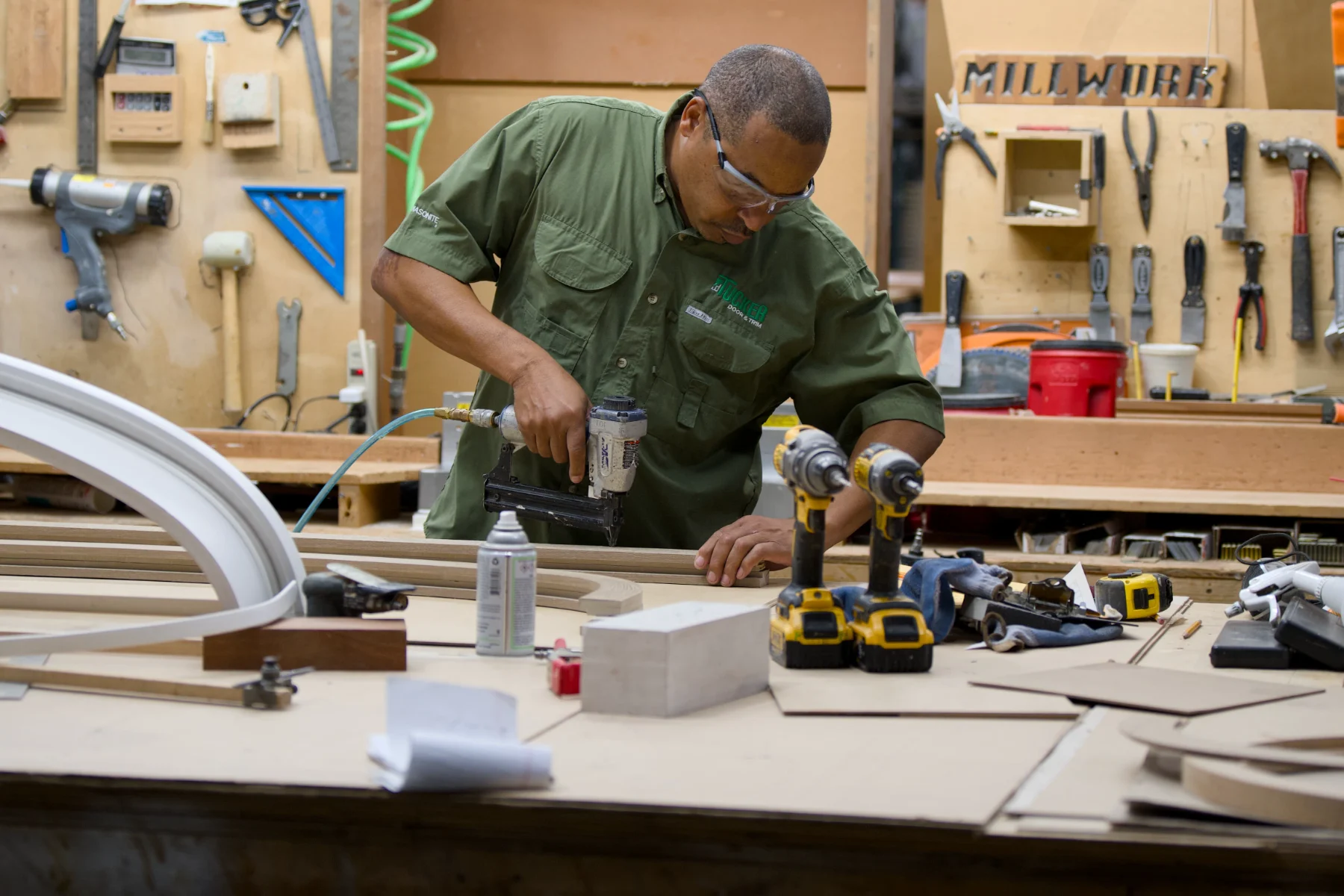
At the Monroe plant, there's an area the crew calls the custom mill shop. It sits inside the same 290,000 square feet as everything else, and another 100,000 is going up.
What happens in there: transoms, radii that go above doors, standalone radii, custom glass dropped into open doors, and SDL work on the higher-end wood. It's all grouped under custom doors and millwork on the product side.
Jason Gert has run production here for 28 years. His description of what the room can take on is short.
You basically can get it drawn on a CAD, and they can make it.
Jason Gert, Production Manager
That's the actual gate. If it can be drawn, it can usually be built. The question is what it costs and how long it takes, not whether it's possible.
The machines behind that sentence
There's a CNC table with two eight-foot beds, so one project can run while the next gets set up. It holds doors down with vacuum. A file drawn in AutoCAD here goes straight to the machine and runs.
It carries multiple head tools that swap out, plus a 90-degree tool for edge work. Multi-point lock preps run on it. So does the rabbet on radius tops for arch transoms.
Tommy Ball runs all of it, including the programming and adjustments. Ask him what keeps him there, and it's not the machinery.
I just love the problem-solving. It never gets old. The days feel short. It's always something different.
Tommy Ball, CNC Machine Operator
There's also a moulder in the mill shop for custom trim. Lumber feeds through and gets milled down in stages to the final profile. That's how a historically matched profile gets made when nothing off a chart works.
Worth knowing before you quote one: a custom profile means knives get made for it. Jason is direct that this pushes the cost up. It's not a catalog pull.
If an architect is writing to a standard on the trim package, the Architectural Woodwork Institute publishes the ANSI-accredited standards that most millwork specs reference. Knowing which grade is being called for changes the conversation early rather than late.
SDL is a skill, and skills take time
The SDL department applies bars to glass doors. Wood bar or PVC bar, in whatever lite configuration the drawing calls for.
Albert Davis does that work. Four-lite, six-lite, eighteen-lite.
SDL is a skill set thing. It's not a rush thing you do. It's not a race or nothing like that. You have to take your time, be patient with it, because you want to send out a good product.
Albert Davis, SDL Department
That's the honest answer on lead time for divided lite work. More lites is more hand work. An eighteen-lite door isn't three times a six-lite in build time; it's its own job.
We do true divided lite as well. The same principle applies.
The cut-downs nobody wants to mess with
Separate from all of that, the exterior door department runs a custom line for size work. Doors trimmed down in height. Doors ripped in width. Dutch doors. The short doors cut for attic access and crawl space access that show up on one house out of twenty and blow up a whole order when you can't source them.
Those are ordinary work here. They just aren't ordinary anywhere else.
What to actually send
To get a price back quickly:
The drawing, if there is one. A CAD file goes furthest. A dimensioned sketch works.
The rough opening, confirmed on site.
Species and finish expectation. Broad species offering doesn't mean every species has the same lead time.
Lite configuration for any divided lite work, and whether SDL or TDL.
What's around it. Sidelites, transom, multi-point prep, custom glass. If the job is leaning on a carried line rather than shop work, the brands page is the faster place to start.
Whether the profile has to match something existing, and a photo or a piece of it if so.
Why the people matter more than the machine list
Bryan Broadnax came here in July of 1999 and worked his way into custom millwork. He started running one of the Commanders.
If you work hard, if you show you're trustworthy and you care about what you do, then you can work your way up to custom millwork as I did.
Bryan Broadnax, Custom Millwork
That's the reason a hard opening gets a real answer instead of a shrug. The bench has people on it who've been solving these for two decades, and they're in the same building as the person who takes your call.
We'd need to confirm feasibility and timing on anything custom before you promise a date. But the conversation is worth having. Send it to us and talk it through with someone who has built it before.
Questions on this one
What format do you want the drawing in?
A CAD file goes furthest, because it can go straight to the machine. A dimensioned sketch works too. What slows things down is a description with no dimensions on it.
Can you match an existing moulding profile?
Often, yes. It means knives get made for that profile, which pushes the cost up and adds time. Send a clear photo with a scale in frame, or a physical piece if the builder can spare one. We'd need to see it before confirming.
What species can you get?
The offering is broad, but availability and lead time vary by species and by week. Send the spec rather than asking in general, and your rep can tell you what's realistic on that job.
Do you do true divided lite, or only simulated?
Both. SDL applies a wood or PVC bar to the glass. TDL is separate lites. Tell us which the drawing calls for, along with the lite count, because that drives the hand work more than the door size does.
Quote it in the Design Portal, or call and talk it through with someone who has built it before.
Get Design Portal access