

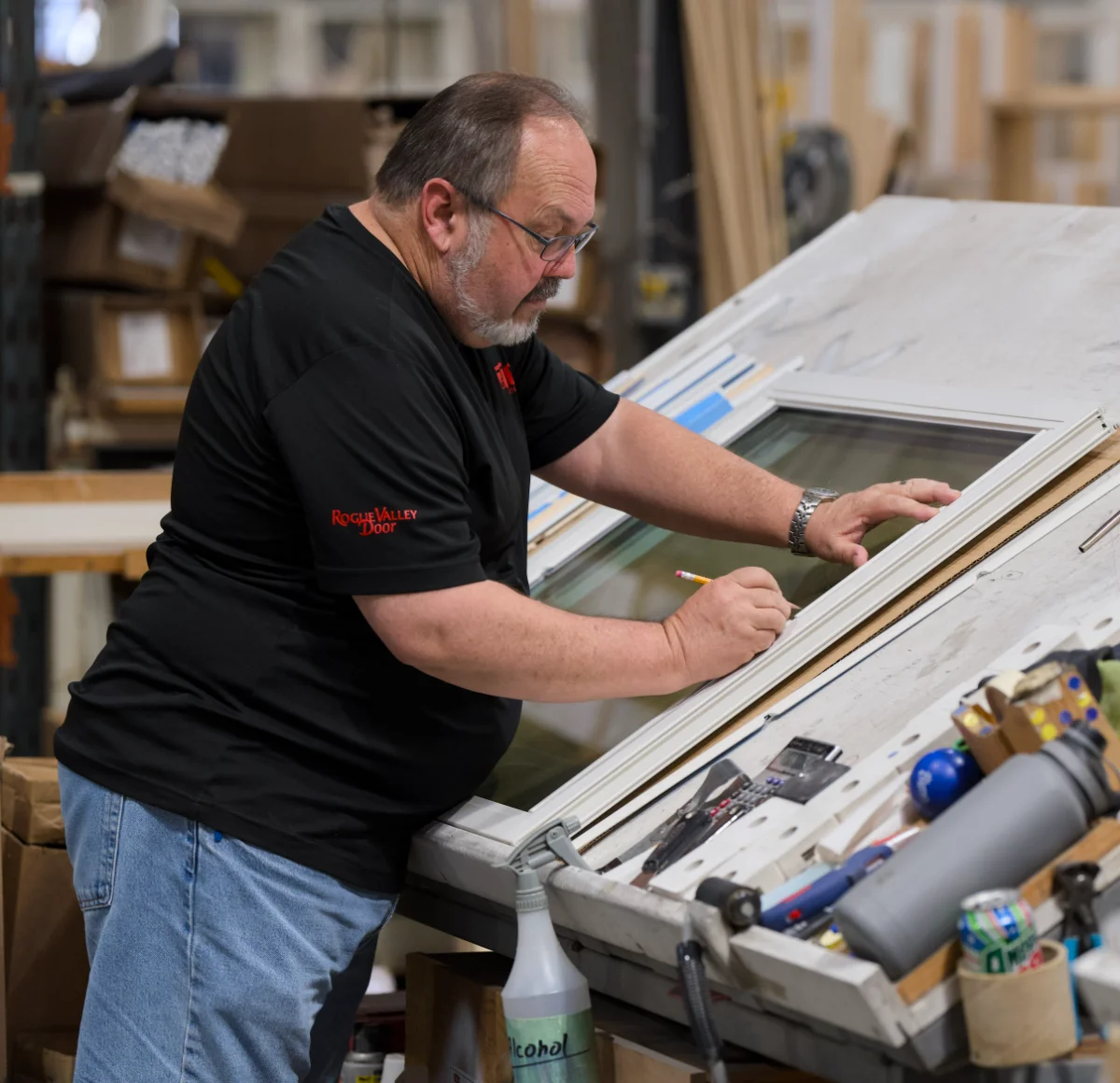
There's no shelf to pull a Tucker window off of. Every unit is built to order, and the shop flow starts with cutting glass. That means the glass package is the first thing locked in and the most expensive thing to change late.
Glass leads; everything else follows
There's no shelf to pull a window off of.
Every window we make is built to that order. The trapezoid, the replacement sash, the standard-looking double-hung on a spec house. All of them get cut and built after the order comes in.
That one fact changes how a window order should be handled at your end.
Chris Kotlowski runs window production in Monroe. Wood, PVC, and vinyl, start to finish. Ask him where the shop flow begins, and he doesn't start at the frame.
The main thing with the windows, you have to get the glass. When you get the glass cut, it goes through our green room where we insulate our glass, and when it comes out the other end, it gets distributed through other departments.
Chris Kotlowski, Window Production
So the sequence is glass, then insulated glass, then sash. Not the other way around.
Up front, someone is entering glass sizes into the cutting table. On a recent run, it was a 366. The optimizer works out the cuts to hold down waste. Curved glass doesn't go through that. It still gets cut by hand.
From there, the glass gets washed, sealed with Duraseal, and goes into the press where the units get built, and argon goes in.
Only then does it split off to the sash lines.
The coating itself comes from Cardinal. Their LoĒ²-270 and LoĒ³-366 product pages lay out what each coating is doing, which is worth a read if a builder asks you to explain the difference.
Wood, PVC, and vinyl are three different builds
They share a plant. They don't share a process.
On wood, a rubber boot goes on first. That boot is the seal. The wood parts get built around it, and the glass is already in there when the sash comes together. Next station clamps it, pre-drills, sets screws and tilt pins. Then weatherstripping, and onto the pallet.
PVC parts come in by lineal footage and get cut down to size. They run through the shapers to mill the ends. There's no boot on PVC, so the sash gets put together empty, and the glass drops in later, on the automatic glazer.
Vinyl gets welded. Four corners are fused, then run through a cleaner that takes the slag and weld off both sides. LeeAnn Gilbert leads the 3300 line and does the flush-up work by hand where the machine leaves something behind.
I like working here because I can see the product from start to finish, and actually get it out the door.
LeeAnn Gilbert, Team Lead, 3300 Line
That difference matters to you for one reason. A glass change on a wood unit and a glass change on a PVC unit don't hit the order at the same point.
What a wrong number actually costs
A standard slab has a second slab behind it. A one-off window doesn't.
If a size is wrong on a custom unit, it isn't a swap. The glass gets cut again, insulated again, and the sash gets built again. That's not a same-week fix.
Barry Williams manages the window division and was in designing the windows we build. He describes the units on the floor as his kids. That's the level of ownership on a shop that builds every unit to order, and it's also why a remake stings.
So before the order goes in:
Confirm the opening, not the eyeball. Especially on shapes.
Lock the glass package early. 270 or 366, argon or not. It's the first thing cut.
Flag anything curved. Curved glass is cut by hand, and that's a different bench.
Know the ceiling. On vinyl, the largest unit we build is a 6062. That's roughly a foot taller and a foot wider than the 5052 you'll see on a lot of jobs. Anything beyond that needs a conversation, not an order entry. Shapes and oversized units usually route through custom millwork anyway.
The last hundred feet
At the end of the line, the sash gets set, stops cut and nailed, stickers and labels on, and the unit gets strapped. Braces go on the bottom so nothing breaks when it gets dragged. Then it goes to the dock, onto the truck, and out on our route to you.
A custom trapezoid built on this floor went out to Reeves Building Supply in Clayton. Reeves took it from there to a job site in Cleveland, Georgia, where Wilkinson Construction Management set it.
That's the whole chain. We build it and get it to the dealer. The dealer gets it to the job. The builder installs it. We don't touch the site, and that's how it's supposed to work.
If you've got a shape or an oversized unit coming, quote it in the Design Portal or send us the opening before you commit to a date. We'll tell you what it takes.
Questions on this one
Do you stock any windows?
No. Every window is built to order. There's no standard size sitting on a shelf, which is why the opening has to be right before the order goes in.
What's the largest vinyl window you build?
A 6062. If a job needs something past that, send it over, and we'll talk through what's possible rather than guess at it.
Can I change the glass package after the order is entered?
That depends on where the order is. Glass gets cut first, so a change caught early is easier than one caught after the units are through the press. Call your rep with the order number and they can check.
How long does a remake take?
That changes by plant and by week, so we won't put a number on it here. What we can tell you is that a remake restarts at the glass, not at the sash. Confirm timing with your rep before you give a builder a date.
Quote it in the Design Portal, or call and talk it through with someone who has built it before.
Get Design Portal access