

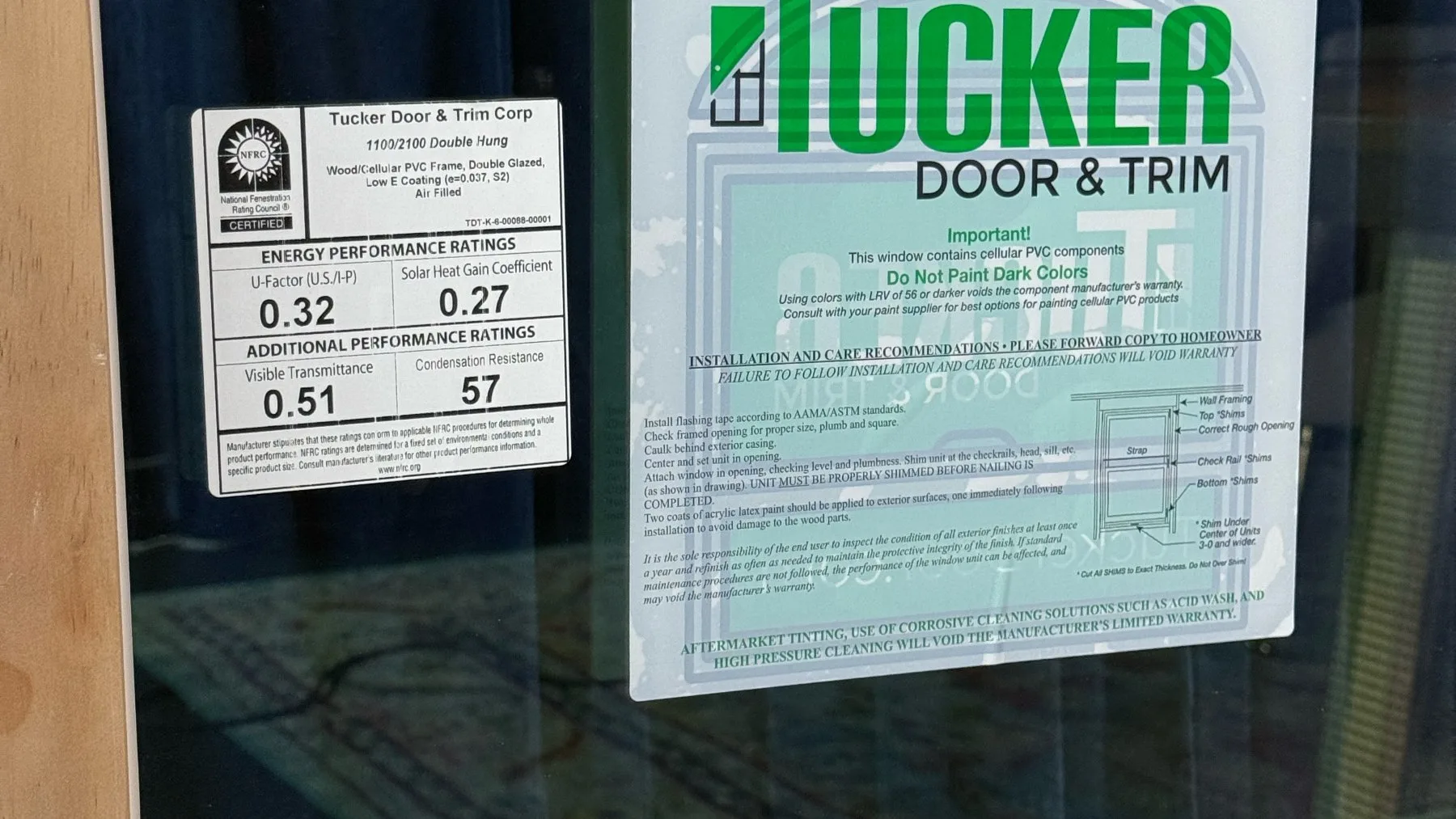
U-factor, SHGC, VT, and CR each measure something different, and only two of them matter for code. Argon lowers U-factor and raises condensation resistance but does nothing for SHGC. Across much of the Southeast, SHGC is the number that fails first, and glass is the fix.
What each number is doing
Someone calls the counter and asks if the window meets code. There are four numbers on the sheet, and only two of them answer that question.
U-factor. Heat moving through the unit. Lower is better.
SHGC. Solar heat gain coefficient. How much of the sun's heat comes through. Lower blocks more.
VT. Visible transmittance. How much light comes through. Higher is brighter.
CR. Condensation resistance. Higher resists better.
The first two are what a code table looks at. VT and CR matter to how the window feels and behaves, not to whether it passes.
These are the categories the National Fenestration Rating Council uses across the industry, which is why the same four show up on any manufacturer's sheet and can be compared directly.
What the numbers look like across our sash types
Double-hung units, from the NFRC table on page 3 of the windows catalog.
Stationary and fixed sash run different numbers. They're on the same catalog page. Don't quote a DHU figure on a fixed unit.
The 3300 series carries its own catalog with the same table reproduced in it, so you can pull those numbers without flipping between documents.
Two patterns worth memorizing
Argon moves U and CR. It doesn't move SHGC or VT.
Look down any sash type. Adding argon drops U-factor by roughly three to four hundredths and picks up several points of condensation resistance. SHGC and VT sit still.
So if a builder needs a lower U-factor, argon is the lever. If he needs a lower SHGC, argon does nothing for him.
366 moves SHGC. It costs you some light.
Going from 270 to 366 takes SHGC from around 0.27 down to 0.20 on most of our sash types. That's a real drop in solar heat.
It also takes VT down three to four hundredths. Slightly less daylight. In a north-facing room, somebody might notice. On a west wall in August, that trade usually reads as a win.
There's a trade-off here, and it's worth naming out loud rather than defaulting.
Where people get stuck
The windows catalog carries an IECC guide by zone and state. Zone 3 covers parts of Alabama, Georgia, North Carolina, South Carolina, and Tennessee, and the guide lists U-factor 0.32 and SHGC 0.25.
Use that guide the way it's meant to be used. It's a reference for narrowing options, not a compliance ruling. Code years get adopted on different schedules, so confirm which one your jurisdiction is on.
Now run a 1300/2300 vinyl double-hung with plain 270 against that Zone 3 line.
U-factor is 0.32. SHGC is 0.27.
The U-factor lands. The SHGC doesn't.
Swap to 366, and SHGC comes down to 0.20. Both numbers clear.
That's the pattern that catches people. Across a lot of the Southeast, SHGC is the number that fails first, and argon won't fix it. Glass will.
Say this, not that
You can tell a dealer's customer what the numbers are. Whether the assembly passes inspection is a different question, and it isn't ours to answer.
Local amendments change things. So does which code year the jurisdiction adopted. So does whether the house is being permitted on a prescriptive path or a whole-building tradeoff, because a tradeoff path can let one component miss while another carries it.
Useful things to say at the counter: “Here are the published numbers for that unit.” “That depends on which code year your county is on.” “We would need to confirm that with the building official.”
Unhelpful things to say: that a window is code compliant anywhere.
The full table, including stationary sash, jamb depths, and the options list by series, is in the windows catalog. If you're spec'ing against a specific zone, quote it in the Design Portal or send us the opening and the target numbers, and we'll tell you what configuration gets there.
Questions on this one
Does argon lower SHGC?
No. Argon affects U-factor and condensation resistance. SHGC and VT stay the same with or without it. If a builder needs a lower SHGC, the glass package is the lever, not the fill.
Are these numbers for the whole window or just the glass?
The catalog lists them as NFRC thermal data by sash type and glass package. If a project requires a certified rating for a specific configuration, we would need to confirm that rather than read it off the table.
Can you tell me whether this window passes code on my job?
No. That call belongs to the building official for the jurisdiction. We can give you the published numbers and help you find a configuration that targets a particular U-factor and SHGC. Whether the permit clears depends on the adopted code year, local amendments, and which compliance path the house is using.
Do fixed and double hung units share the same ratings?
No. Stationary and fixed sashes are listed separately in the catalog and run different numbers. Quoting a DHU figure on a fixed unit is one of the more common mix-ups.
Quote it in the Design Portal, or call and talk it through with someone who has built it before.
Get Design Portal access